




Be the first to read new publications, subscribe to our Newsletter
A Multitude of Labels for "Fair and Sustainable" Chocolate
Why do so many labels exist—and why do cacao-farming families continue to struggle despite them?

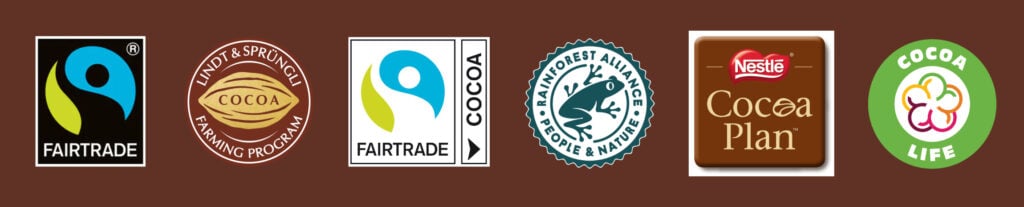
Quality labels, QR codes, frogs, flowers, golden pods: today, when you turn over a chocolate bar, you discover a whole little universe dedicated to sustainability. There have never been so many labels and logos—and at the same time, never so many unresolved problems in the cacao sector: child labor, poverty, deforestation. How does all this fit together? And what do these labels actually mean—for producers, for companies, and for us as consumers?
"Could you tell us a bit about the reliability of labels?" This question comes up almost every time—most recently at the Bean-to-Bar trade show in Chemnitz. My spontaneous answer: "It's better than nothing." And yet, it feels too simplistic. Because the honest answer is more complicated—and more unsettling. Labels have made things happen. But they don't solve what's truly wrong in the cacao sector. That's precisely why it's worth taking a closer look.
Between Guidance and Overkill
To be honest, the sustainability information on chocolate packaging sometimes resembles Times Square at night: everything's flashing, everything wants attention—and in the end, all that remains is confusion. Each label has its own logic, its own criteria, and its own promises. Even industry professionals quickly lose track.
What actually lies behind the most common labels?
Overall, well-known sustainability labels guarantee that cacao is produced according to slightly better environmental and social standards and that cacao-farming families receive occasional support—without fundamentally solving structural problems such as poverty or living incomes. The Rainforest Alliance label—the green frog—focuses more on environmentally friendly cultivation, while Fairtrade Max Havelaar aims more at stable cacao prices, social standards, and a living income.
If you're wondering what happened to Utz—used for many years by Migros—Utz and Rainforest Alliance merged a few years ago. Today, there's only the frog.
As for the Fairtrade label, there's actually a distinction that almost no one knows about: the dark Fairtrade label means that all ingredients for which a Fairtrade label exists—meaning sugar, vanilla, oranges—must be certified. The light label, on the other hand, indicates that only the cacao is Fairtrade certified.
Mass Balance: The Invisible System Behind It
The so-called "mass balance" system is a central but poorly understood mechanism of many labels. The principle: you pay for certified cacao, but it often doesn't physically end up in your chocolate. Indeed, cacao beans are mixed throughout the supply chain with beans from different regions and different countries. The additional premium paid does go to cacao cooperatives, but the physical traceability of the cacao beans remains abstract.
Advantages
- More farming families can participate
- Scalability
- Lower-priced products
Disadvantages
- Disconnect between product and origin
- Less transparency
- Loss of consumer trust
The situation is slightly different for organic: here, product flows must remain separate, which means that, if all goes well, the product should be organic where indicated. Organic is therefore often more expensive—for consumers, but also for producers, who must bear the high certification costs.
Are Labels a Thing of the Past? A Nuanced Look
I must admit: for me, labels on chocolate packaging are somewhat outdated—at least in Switzerland. But is this really the case, and does it apply to everyone? And if so, why, after all these efforts and successful implementation? Here's my analysis in five points:
1. Awareness: without labels, we wouldn't be where we are
Fairtrade & Co. have had an enormous impact. They shook up consumers and companies and created fundamental awareness: behind chocolate, there are people, prices are linked to human rights, and supply chains can be shaped. Without this groundwork, many of today's debates about living incomes or child labor would be hard to imagine.
2. Mainstream: success—with side effects
Labels have achieved their goal: they've conquered the mainstream—including major corporations. This has expanded their reach, but also diluted their impact. Sustainability has become scalable—but at the same time standardized and often disconnected from real change on the ground.
3. Breaking away: pioneers are taking different paths
Many fair trade pioneers, such as Claro or Gebana, have turned away from labels. The new generation of small producers also often forgoes them. The reasons: high costs, limited benefits, and proximity to large corporations. They're betting instead on direct trade—with more relationships and often more impact.
4. The price of the system: responsibility is outsourced
Label standards are used by large companies, but responsibility is often delegated downward: to cooperatives, producers, and states. They bear the costs and risks. Meanwhile, brands promote "sustainable chocolate." The fundamental problem remains: labels replace neither fair purchasing practices nor prices guaranteeing a decent income.
5. A tool, but not a structural solution
Labels constitute an important toolkit for companies: they set standards, provide benchmarks, and make it possible to highlight progress and gaps. Organizations such as Fairtrade or Rainforest Alliance are indispensable for international policy work and corporate support. The voluntary nature of the standard limits its scope or confines it to marketing. They cannot solve any structural problem—neither poverty, nor child labor, nor deforestation.
Their value depends entirely on how seriously companies implement them.
What follows from this—and what must change—we'll return to later.
What does the research say?
A study published in early 2026 (Romano et al., Discover Sustainability) examined the impact of major sustainability labels on the living conditions of cacao producers. Conclusion:
Rainforest Alliance: slight gains in cacao yield, income, and farming practices—but little clarity regarding deforestation, biodiversity, child labor, and food security.
Fairtrade: better results in income, education spending, and cooperative strength—but limited progress in food security, child labor, and gender equality.
Organic: Clear environmental benefits (fewer chemicals, healthier soils, more biodiversity)—but often lower yields and less profitability. Premiums rarely compensate for this.
Study conclusion: mainstream labels enable gradual economic improvements. Organic achieves the best results ecologically, but remains economically demanding. No label fully closes income gaps.
When Companies Create Their Own Logos
Besides well-known labels, other logos appear on many packages—less easily identifiable, but ubiquitous and also purely voluntary:
- Lindt Farming Program: golden pod, dark red circle
- Nestlé Cocoa Plan: brown logo with a pod, red Nestlé logo
- Cocoa Life (Mondelez, for Toblerone, Milka, Suchard, Daim, etc.): green circle with a flower
These logos represent each company's own sustainability programs. Companies implement them themselves—with "their" producers in "their" supply chain. The goals are familiar: higher yields, fewer pests, access to education, combating child labor, and ensuring access to cacao.
The problem: unlike independent labels, there's a lack of uniform standards, comparability, and rigorous controls. Transparent reporting is rare, sanctions practically nonexistent. And above all: the programs practically don't work with binding cacao prices guaranteeing a living income.
This is precisely what's becoming apparent today. In Côte d'Ivoire and Ghana especially—the two largest cacao-producing countries—the warning signs of a storm are evident. The living conditions of cacao producers have never been this bad in a long time. A key reason: the brutal collapse of prices. None of the major programs—neither Cocoa Life, nor the Lindt Farming Program, nor the Nestlé Cocoa Plan—has been able to cushion the violence of this collapse. Because none of them was structurally equipped to face this fall.
An Initial Assessment
The problem lies not primarily in the principles of fair trade, but in the balance of power in the market. Higher prices regularly meet resistance from major corporations, even when producing countries like Ghana or Côte d'Ivoire want to impose them.
At the same time, as consumers, we expect cheap, standardized chocolate. To achieve this, companies blend cacao from different sources and set up their own sustainability programs to ensure this flexibility.
This is how a multi-billion system has developed around company-owned labels. Meanwhile, the independent Fairtrade system sticks to common minimum standards—and suffers pressure precisely for this reason from those who should change the most.
What's Needed Now
Beyond all these labels, programs, and promises, an unsettling question remains: what's really needed? In my view, here are the answers:
1. A living income—the central lever
Chocolate corporations, traders, and retailers must pay cacao-farming families a price guaranteeing a living income—independent of current market prices.
This means:
- Prices that actually allow people to live
- Purchasing practices that guarantee these prices
- Willingness to bear the additional costs throughout the value chain
What is a Living Income?
A living income is the income a family needs to lead a dignified life, meaning sufficient to feed themselves, have access to clean water, housing, education, healthcare, and build a reserve for emergencies. It's measurable and calculable at the regional level—and it's up to companies to organize their purchasing practices in a way that makes this income possible.
This includes:
- Prices that actually allow people to live
- Purchasing practices that guarantee these prices
- Willingness to bear the additional costs throughout the value chain
In the cacao sector, this means:
Farmers must be able to live from their work—without resorting to child labor or destroying their livelihoods.
Important: A living income is not a bonus. It's a human right.
2. Binding laws—and their enforcement
Without clear rules, sustainability remains a voluntary effort. And voluntary isn't enough. The EU is showing the way: clear legal requirements for human rights, environment, and transparency throughout the supply chain—with an obligation to implement. Switzerland must not stay on the sidelines.
Here too, we need:
- Binding laws that guarantee respect for human rights and environmental standards throughout the supply chain
- No loopholes allowing companies to shirk their responsibilities
- Rigorous monitoring and enforcement—not just reporting.
3. Transparency over greenwashing
Transparency is needed on how companies actually source: at what prices, under what contractual conditions, with what risks for producers.
4. Draw inspiration from the new generation of chocolatiers
A growing number of small producers are showing there's another way:
Direct trade, stable and high prices for good quality, visible relationships with the people behind the cacao—and a product that reflects this value. Often closer to true sustainability than large anonymous systems.
5. Labels as a real lever—not just a checklist
Labels can help implement legal requirements. But only if they're taken seriously. Those who use them as a simple checklist, without genuine collaboration with producers, achieve no results: no reduction in child labor, no fight against poverty, no protection of forests and water resources. Impact doesn't come from the label, but from everything that happens behind the scenes.
No label will be THE solution on its own. T hat will come primarily from what companies and consumers are willing to pay for this exceptional product that is chocolate !